
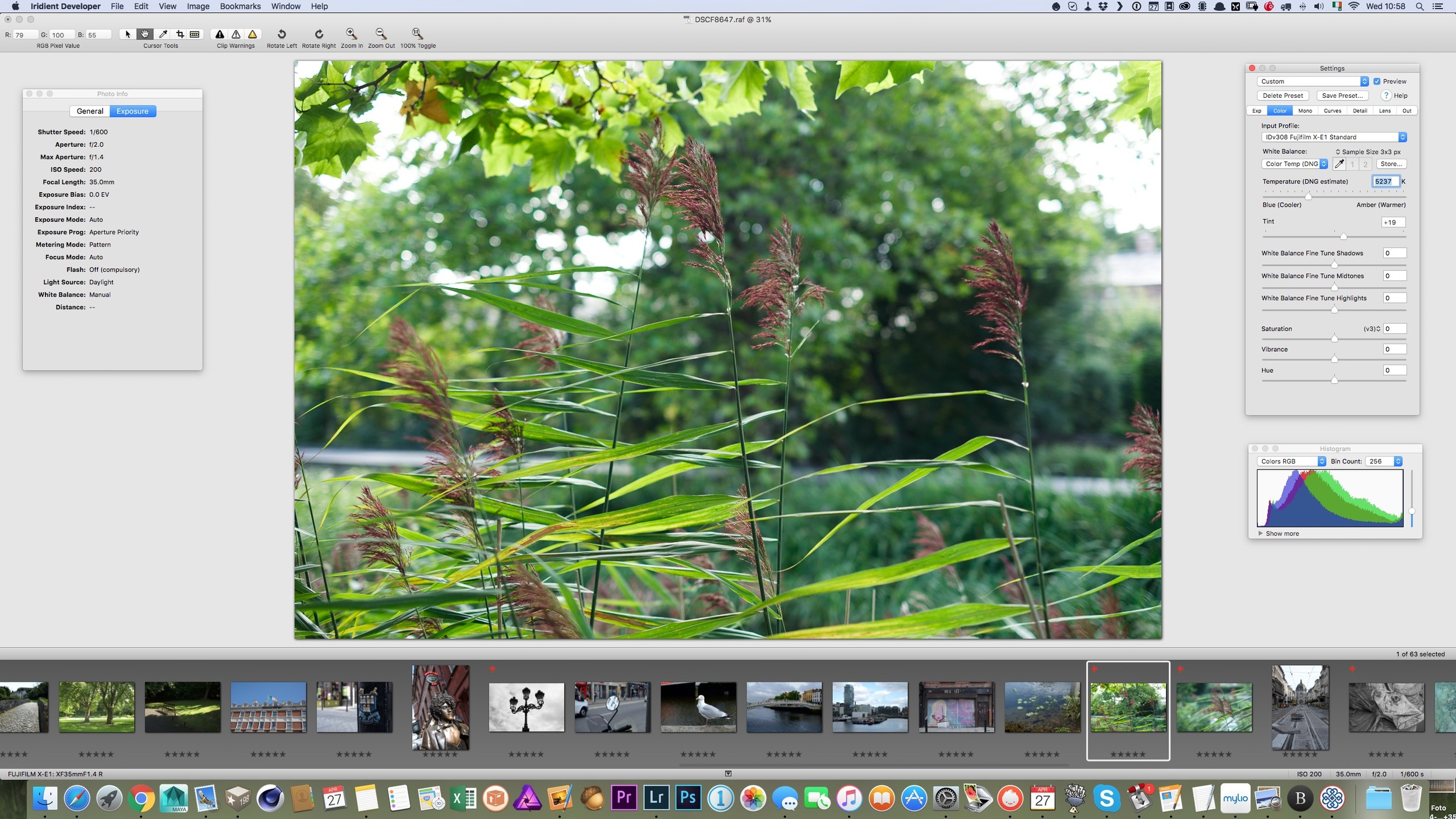
Iridient Developer has received a new update this weekend. The new version adds support for compressed raw files for the X-Pro 2 along with raw support for a number of other cameras. The update also has some important bug fixes, including a fix for some bugs in OS X.
The complete list of cameras which have been added are as follows:
- Canon: 80D, 1D X Mark II, 1300D (Rebel T6, Kiss X80) and PowerShot G7 X Mark II.
- Nikon: D500 and D5.
- Sony: A6300 (ILCE-6300), A68 (ILCA-68) and RX10 III (DSC-RX10M3).
- Panasonic: DMC-GX80 and DMC-GX85.
- Fujifilm: X-Pro2 compressed RAF.
- Leica: M-D (Typ 262).
- BlackMagic: URSA, URSA 4.6K, URSA Mini 4K and URSA Mini 4.6K.
- DJI: FC550 (Xenmuse X5), FC350 (Inspire 1 and Phantom 4), FC300X (Phantom 3 Pro) and FC300S (Phantom 3 Advanced).
- HTC: One A9 and One M9.
- Samsung: Galaxy S7.
You can see full details on the Iridient digital website.
Speaking of iridient Developer, my long awaited X-Trans guide for Iridient Developer is nearly finished, and I hope to have it out sometime later this week, so stay tuned!

Last week was a very interesting week for those who want to shoot video professionally. We saw the launch of 3 cinema cameras. Well, four if you count the new iPhones. At IBC in the Netherlands, Canon, Nikon and Fujifilm announced their new cinema cameras. For Canon, it was a new form factor and price point for their cinema lineup, and for Nikon and Fujifilm it was their first entry into this space.

I’ve been exploring the challenges of processing Fujifilm X-Trans files ever since the original X-Pro 1, sharing tips, sharpening methods, and even an eBook along the way. Historically, Lightroom struggled with these unique raw files, demanding extra workarounds. But with Adobe’s latest update, that’s finally changed. Processing Fujifilm files is now straightforward, and it mostly comes down to one simple checkbox.

A year and a half ago, I wrote a piece about the Fujifilm X100VI and how it was (at the time) the last of the rangefinder style cameras. When I wrote that piece, Fuji had discontinued the XE-4 and the X-Pro3, and there was no immediate sign of replacements. I had speculated that Fuji had ended these lines as the X-T Series and X100 lines were more popular. As an X-E4 owner, I was saddened but resigned to the fact. But luckily, I was wrong and today, Fujifilm announced the new X-E5.

Fujifilm has just released its long rumoured, and much teased “half” digital camera, and it has, to put it mildly, decided opinions. The camera, which looks like a tiny X100 series, is an homage to half frame film cameras of old, with a 1.0 type sensor mounted vertically and a vertical screen on the back. Fuji has also designed the software of the camera to mimic film as much as possible, even including a film mode. When activated, this mode doesn’t let you see what you’re capturing it until you reach the end of the roll and “develop” it in the companion camera app. It’s either a nice nod to nostalgia or a gimmick, depending on who you ask. But the one thing Fuji really, really wants you to know is that this camera is “Fun”.

Our old friends at Fuji Rumors haver caused quite a bit of a stir in the Fuji community with a recent rumour about a new camera that Fujifilm is working on. According to the rumour, the camera which probably won’t be released until 2025 will have a new sensor that is of a different size to one that Fujifilm has used before! As you can imagine this has caused rampant speculation on various social sites. The leading candidate for this “sensor size that Fujifilm hasn’t used before” is Full Frame. But if this came true it would upend years of Fuji insisting that Full Frame isn’t something they want to do.

Back in April my wife and I took a road trip to the northern most region in Ireland, the Inishowen peninsula in Co. Donegal. We were there for a few days and took the opportunity to photograph the northern most point on the island of Ireland, as well as some of the incredible beaches in the area.

I’ve been a Fujifilm shooter for quite some time now. The original X100 still sits on a shelf in my office, and I’ve had a total of 5 different Fujifilm cameras over the years. While the original X100 wasn’t my first Fuji camera, it was probably the one I used for the longest. Since then, there have been numerous iterations of this camera, each better than the previous one. I never really bothered upgrading the X100 because my other Fuji cameras pretty much did the same thing, but with the additional option of changing lenses. Now with its latest iteration, is it time to finally upgrade? And what does the X100VI release say about the rest of the Fuji Lineup?

In this video, I go back to basics and set out to enjoy the creative process of taking photos in order to overcome a bad case of creator block and imposter syndrome. I went for a Photo Walk by the grand canal in Dublin with my Trusty Fujifilm X-E4 and talked about how you sometimes need to take photos just for yourself and enjoy the process as a form of meditation.

The Fujifilm Fujinon 16-80mm lens is one I’ve wanted for a long time, but it has been surprisingly difficult to get hold of here in Ireland. Ever since it came out, the standalone version has been back-ordered, and it was only really available here as part of a kit. I finally managed to get one second hand a couple of months ago, and I’ve been using it a lot since, including taking it on several trips. So, I wanted to do a non-technical review of this lens for those who might be interested.
I’ve had my Fujifilm X-E4 for a long time now, and for the most part it’s a great little camera. I’ve used it as my main “lightweight” travel and walk-around camera for years now. Any time I want to bring a camera with me and I don’t want to lug my Canon R6II, I throw the Fujifilm in the bag. I had originally bought it to replace my ageing Sony a6000 for street photography, but that never really panned out. Mainly because I didn’t do street photography as much any more, but also, an annoying bug in the camera made it difficult to use with my style of street photography. But I finally found a solution.